
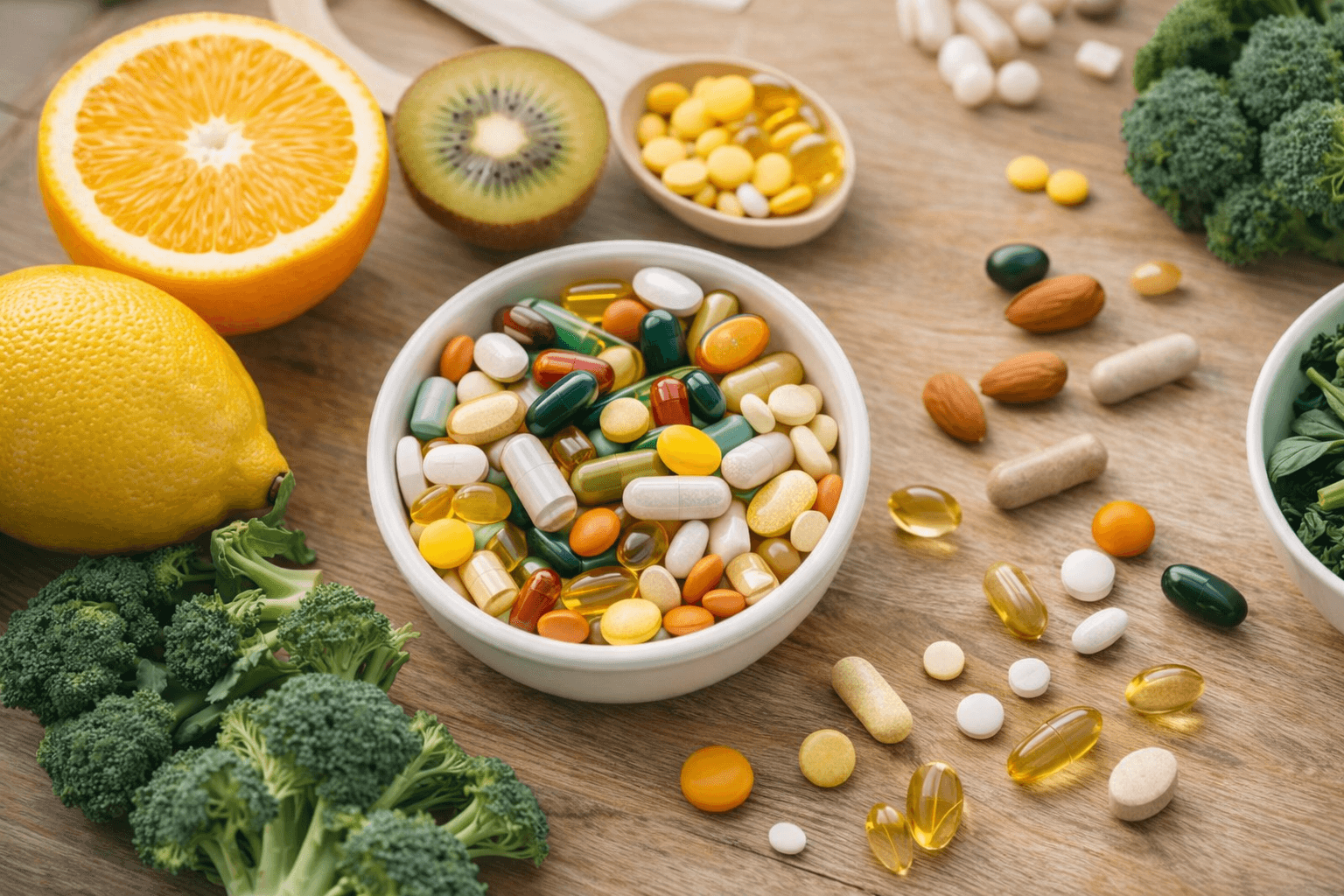
Vitamins & Supplements: What’s Worth It vs Hype
Vitamins and supplements sit in a strange place in health culture. Some are genuinely useful in the right context. Others are oversold, poorly matched to the person taking them, or marketed with claims that go beyond good evidence. [S1] [S2] [S3]
The balanced view is simple: supplements can help when there is a documented need, a higher-risk life stage, limited dietary intake, or a clinician’s recommendation. But they are not a shortcut for poor diet or a guaranteed route to better health. [S1] [S2] [S3]
This is general information and not medical advice. For personal decisions, especially in pregnancy, childhood, chronic disease, or while taking medication, speak with a qualified clinician or pharmacist. [S2] [S4]
First principle: food comes first
WHO states that the foundation of a healthy diet is a variety of minimally processed and unprocessed foods low in unhealthy fats, free sugars, and sodium. The NHS likewise notes that most people should be able to get the nutrients they need from a varied and balanced diet. [S3] [S2]
That does not mean supplements are useless. It means they work best as targeted support, not as a replacement for the basics.
When supplements may make sense
Pregnancy and pre-pregnancy
This is one of the clearest evidence-based cases. The NHS advises folic acid before pregnancy and during the first 12 weeks of pregnancy. [S4]
Vitamin D in some circumstances
Vitamin D is one of the more commonly discussed supplements because sunlight exposure, diet, skin tone, geography, and lifestyle can all affect status. NIH notes vitamin D is needed for calcium absorption and bone health, while the NHS also warns against excessive dosing. [S5] [S6]
Iron when deficiency or higher need is confirmed
NIH notes iron is needed for growth and development and to make hemoglobin. But iron is not a “more is better” nutrient; unnecessary supplementation can be harmful. [S7]
Vitamin B12 for people at risk of low intake or absorption
NIH notes vitamin B12 helps keep blood and nerve cells healthy. This can be especially relevant in certain dietary patterns or absorption problems. [S8]
What is often hype
“Immunity boosters” with vague claims A supplement label may imply broad immune benefits without showing that the product meaningfully improves outcomes in healthy people. Good marketing is not the same as good evidence.
Megadoses “just in case” High-dose products often create the illusion that more equals better. That is not how micronutrients work. The NHS specifically warns that too much vitamin D can be harmful. [S6]
Long stacks for energy, beauty, focus, or detox Many combination products bundle multiple ingredients, making it hard to tell what is useful, unnecessary, or interacting with medication. The more complex the stack, the easier it is to overspend and the harder it is to assess effect.
A practical way to think about supplements
Worth considering
A supplement is more likely to be reasonable when:
- there is a documented deficiency or strong clinical suspicion
- you are in a life stage with known higher requirements
- your diet regularly excludes a key nutrient source
- a clinician recommends it based on your history or labs
Approach with caution
Be more skeptical when:
- the marketing promises everything at once
- the product relies on testimonials instead of evidence
- the dose is very high for no clear reason
- the label contains many ingredients with unclear necessity
- you are taking medications and have not checked interactions
Common examples, briefly
Multivitamins NIH notes multivitamin/mineral supplements are widely used, but they should not replace professional guidance or a balanced diet. For some people, they may fill modest nutritional gaps. For others, they add cost without much benefit. [S1] [S9]
Vitamin D Reasonable in some settings, but dose matters. [S5] [S6]
Iron Useful when needed; not a casual wellness add-on. [S7]
Vitamin B12 Important for certain diets and absorption patterns. [S8]
“Hair, skin, nails” blends These often market aspiration more than medical necessity. Unless there is a true deficiency or defined clinical reason, the evidence is frequently thinner than the branding suggests.
Red flags before you buy
- claims that sound like treatment promises
- very high doses without explanation
- no clear third-party quality information
- poor labeling transparency
- influencer-heavy promotion with little clinical grounding
When to ask a clinician before taking supplements
You should get individualized guidance if you are:
- pregnant or trying to conceive
- breastfeeding
- buying supplements for a child
- living with kidney disease, liver disease, diabetes, heart disease, or another chronic condition
- taking prescription medicines
- preparing for surgery
- managing fatigue, weight loss, numbness, or other symptoms that may need diagnosis rather than self-treatment
Sensible consumer rule
A good default is: test or assess first, target second, review later.
That is a far better strategy than buying five products because the internet says they are “must-haves.”
Key takeaways
- Supplements can be useful, but only in the right context.
- A balanced diet remains the foundation.
- Folic acid in pregnancy planning is one of the clearest examples of targeted supplementation.
- Vitamin D, iron, and B12 may matter for certain people, but not automatically for everyone.
- More is not better; high doses can cause harm.
- Symptoms deserve medical assessment, not just supplement shopping.
FAQ
Are multivitamins necessary for everyone? No. They may help some people, but they are not automatically necessary for healthy adults eating a balanced diet. [S1] [S2]
Is it safe to take large doses of vitamins “just in case”? Not necessarily. Some vitamins and minerals can be harmful in excess. [S6]
Which supplement has the strongest routine use case? Folic acid around conception and early pregnancy is one of the clearest examples in mainstream public health guidance. [S4]
Can supplements replace healthy eating? No. WHO and the NHS both point back to overall diet quality as the foundation. [S2] [S3]
Should I take iron if I feel tired? Do not assume. Tiredness has many causes, and iron is best used when deficiency is identified or strongly suspected by a clinician. [S7]
References & Sources
- [S1]
NIH ODS Multivitamin/mineral Supplements
View Source - [S2]
NHS Vitamins and minerals
View Source - [S3]
WHO Healthy diet fact sheet
View Source - [S4]
NHS Vitamins in pregnancy
View Source - [S5]
NIH ODS Vitamin D
View Source - [S6]
NHS Vitamin D
View Source - [S7]
NIH ODS Iron
View Source - [S8]
NIH ODS Vitamin B12
View Source - [S9]
NIH ODS MVMS Health Professional
View Source